2,990 $
Description
It comes with engine ROS 100cc
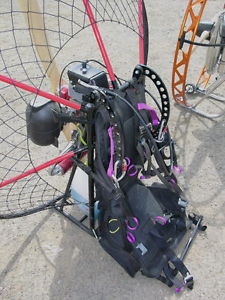
The machine has a wide enough base to resist tipping over on the ground.Ground Handling & Kiting (5): Standing and walking around were comfortable. The J-bars will not rub your shoulders if you have the ground hanging straps cinched up but you'll feel them occasionally. It was easy to keep the machine hiked up high enough to prevent feeling pulled backwards. A forward lean of about 20 kept me upright without exertion.Ingress is easy although you are sitting on the ground which makes getting up slightly harder.Launch (5): The cage is wider than most to accommodate the large prop so the lines pull harder against it. On one inflation they did catch on something but on all the others (about 4) others they rode up smoothly. Running is very easy on this machine, the J-bars may help here slightly. I don't remember my legs hitting the cage bottom and, if they did, it was not a factor in launching. Torque twist is very well controlled. UnfortunatelyThe netting is attached to the hoop, presenting a smooth surface for lines to ride up during inflation. Radial arms are stout and screw in so the cage should easily handle power forwards or trike launches.Climbout (6): This is a very well balanced machine, even at full power, regarding torque twist.It is equipped with a kick in strap that hangs in just the right place. Put your foot down and kick out the seat without ever letting go of the brakes. There's more to this kick-in system than meets the eye. It uses a metal tube so the weight keeps it positions. Simple and effective.Flight (5): Flying the machine is very comfortable. The J-bars were slightly below eye level and impede visibility only slightly.The harness was well enough padded and adjustments on the seat bottom lip were a nice touch.J-bars reduce the pilot "wiggling" in turbulence. This system strikes a balance by transferring some movement of the glider but in a dampened fashion.Torque (7): This is well handled although it's critical, as with most, not to tighten the chest strap and bring the risers together.Thrust (8): This has amazing thrust for its weight. That's what you get by fitting such a large prop (51" vs typical 46-48").Endurance (6): I was unable to test this but suspect it would fly an average pilot about 2.5 hours on an average beginner wing from a full 1.8 gal tank.Vibration (6): Nothing unusual noted so it must have been good.Sound (5.5): Slightly better than average mostly from the ground perspective. That may be due to the larger, slower spinning prop.Gas tank to prop clearance was over 4" so it should resist prop/fuel contact in a hard landing.The frame bottom front has a sharp angle so if you hit something while ground skimming it may catch.Construction (6): It is very well built and seems strong for it's weight. It is mostly aluminum which means no rust. Having the netting riveted to the hoop pieces means less drag than the velcro slide-through style albeit at some trade-off in repairability.Reparability (6): Damage resistance is good and it should be easy repair. Having lots of straight parts helps. A broken radial arm can be replaced easily but you must have the screw-in fitting although the replacement expense would be minimal.The netting would be harder to replace since the rivets would have to be removed on all the hoop pieces.Transport (7): This is a strong point. It'll go into a small space with minimal fuss although realistically expect about 45 minutes to assemble it from start to finish after shipping.Overall: The machine would be a good purchase for anyone looking for an all-around fun flyer. Long time instructor Eric Dufour swears by the floating J-bars that they are easier to launch and his success at training new students suggests that's likely.
| Brand: | ROS 100cc SD | MPN: | Does Not Apply |
| Model: | Nomad | Country/Region of Manufacture: | United States |
Condition:Very good condition , works great.30 hours of flying. There was no damage.Has never been an accident.
Comes with:SD Paramotor and harness.ROS 100cc engine.Propeller.
"After I saw your payment has been entered into my paypal account, will take 1-3 days to ship your 3 big boxes and confirm the tracking number""Packaging I did well to keep in order to avoid damage in the process of shipping the package."The paramotor is located in BURLESON, TX, US, stored in 3 big boxes a year ago| Easy to startCruise controlFootrestSolid & safe frameThe SD frame recognized for its solidity, is made of aluminum type 6061-T6. The cage easily breaks down in 4 parts and each sections of the cage is finished with a rubber seal to allow for a perfect assembly between each part. With this solid cage, it is possible to use the engine during inflation without the fear of the lines touching the propeller, even with the trike. |
| ||||||||||||||||||||||||||||||||||||||||