Back to the main page Back to category Compound
watch details
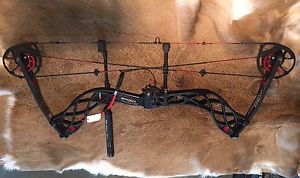
Bowtech Carbon Knight
Estimated price for orientation: 875 $
Category: Compound
Class:
Description Archery Type: Bow Hunting Dexterity: Right Hand MPN: Does Not Apply Brand: Bowtech Overall Length (in.): 32in. Draw Weight (lbs.): 60lbs. Model: Carbon Knight Draw Length (in.): 29in. Material: Carbon Fiber Color: Black and Red UPC: Does not apply
Includes Octane Stabilizer Apex Wrist Sling QAD Arrow Rest
DescriptionThe Bowtech Carbon Knight caused a stir when it was released in 2013. The extremely lightweight (only 3.2 lbs!!) bow has a whopping IBO speed of 335 fps making it a powerful hunting bow. The bow offers a smooth draw using a binary cam design which was designed for symmetry, synchronization and simplicity.Materials & DesignBowtech’s Carbon Knight compound bow only weighs in at 3.2 lbs thanks to the Carbon Knight riser which, funnily enough, is made from Carbon Fiber. In comparison to aluminum risers, the carbon versions offer great flexibility to smaller shooters as once the accessories are added the bow can be quite weighty for some.Due to the additional cost associated with a carbon fiber riser, this is a bow that is probably on everyone’s wish list, but most would spend the money on upgrading standard gear or buying accessories.To strong and experienced shooters the 0.5 lbs weight reduction may not be a huge selling factor, and some people have reported that the standard string provided with the bow has frayed relatively quickly.Cam InformationThe Bowtech Carbon Knight compound bow uses a “conventional” binary cam design which is also adopted by the Carbon Rose. The binary cam design allows for a perfectly synchronized bow with little maintenance.The system also allows for adjustment of the draw length setting without the need for new cam modules, and is adjustable in ½” increments (refer to the table below for mode positions).In order to change the draw length, you use a 7/64 hex wrench to remove the module screws that attach the modules to the cams. Using the module index number on the cam and the numbers on the module, move the module to the relevant number (using the table below).
Description
| Archery Type: | Bow Hunting | Dexterity: | Right Hand |
| MPN: | Does Not Apply | Brand: | Bowtech |
| Overall Length (in.): | 32in. | Draw Weight (lbs.): | 60lbs. |
| Model: | Carbon Knight | Draw Length (in.): | 29in. |
| Material: | Carbon Fiber | Color: | Black and Red |
| UPC: | Does not apply |
Includes Octane Stabilizer Apex Wrist Sling QAD Arrow Rest
DescriptionThe Bowtech Carbon Knight caused a stir when it was released in 2013. The extremely lightweight (only 3.2 lbs!!) bow has a whopping IBO speed of 335 fps making it a powerful hunting bow. The bow offers a smooth draw using a binary cam design which was designed for symmetry, synchronization and simplicity.Materials & DesignBowtech’s Carbon Knight compound bow only weighs in at 3.2 lbs thanks to the Carbon Knight riser which, funnily enough, is made from Carbon Fiber. In comparison to aluminum risers, the carbon versions offer great flexibility to smaller shooters as once the accessories are added the bow can be quite weighty for some.Due to the additional cost associated with a carbon fiber riser, this is a bow that is probably on everyone’s wish list, but most would spend the money on upgrading standard gear or buying accessories.To strong and experienced shooters the 0.5 lbs weight reduction may not be a huge selling factor, and some people have reported that the standard string provided with the bow has frayed relatively quickly.Cam InformationThe Bowtech Carbon Knight compound bow uses a “conventional” binary cam design which is also adopted by the Carbon Rose. The binary cam design allows for a perfectly synchronized bow with little maintenance.The system also allows for adjustment of the draw length setting without the need for new cam modules, and is adjustable in ½” increments (refer to the table below for mode positions).In order to change the draw length, you use a 7/64 hex wrench to remove the module screws that attach the modules to the cams. Using the module index number on the cam and the numbers on the module, move the module to the relevant number (using the table below).
DescriptionThe Bowtech Carbon Knight caused a stir when it was released in 2013. The extremely lightweight (only 3.2 lbs!!) bow has a whopping IBO speed of 335 fps making it a powerful hunting bow. The bow offers a smooth draw using a binary cam design which was designed for symmetry, synchronization and simplicity.Materials & DesignBowtech’s Carbon Knight compound bow only weighs in at 3.2 lbs thanks to the Carbon Knight riser which, funnily enough, is made from Carbon Fiber. In comparison to aluminum risers, the carbon versions offer great flexibility to smaller shooters as once the accessories are added the bow can be quite weighty for some.Due to the additional cost associated with a carbon fiber riser, this is a bow that is probably on everyone’s wish list, but most would spend the money on upgrading standard gear or buying accessories.To strong and experienced shooters the 0.5 lbs weight reduction may not be a huge selling factor, and some people have reported that the standard string provided with the bow has frayed relatively quickly.Cam InformationThe Bowtech Carbon Knight compound bow uses a “conventional” binary cam design which is also adopted by the Carbon Rose. The binary cam design allows for a perfectly synchronized bow with little maintenance.The system also allows for adjustment of the draw length setting without the need for new cam modules, and is adjustable in ½” increments (refer to the table below for mode positions).In order to change the draw length, you use a 7/64 hex wrench to remove the module screws that attach the modules to the cams. Using the module index number on the cam and the numbers on the module, move the module to the relevant number (using the table below).